고려대학교 교수소개
Knowledge & Innovation

- 생명과학대학
- 생명과학부
- 최해웅
소개

Prof. Hae Woong Choi
최해웅 교수
Tel: 02-3290-3412
E-mail: haewoongchoi@korea.ac.kr
- About Professor
- Lab Members
- Publication
- Research
- Teaching
- Available Positions
Profile
Education
2008.8 – 2014.5 Ph.D. Department of Pathology, Duke University, USA
2005.3 – 2007.2 M.S. Division of Life Sciences, Korea University, South Korea
1998.3 – 2005.2 B.S. Division of Life Sciences, Korea University, South Korea
Professional Experiences
2023.9 – Current Associate Professor, Division of Life Sciences, Korea University, South Korea
2024.11– 2026.7 Vice Dean, University College, Korea University, South Korea
2019.9 – 2023.8 Assistant Professor, Division of Life Sciences, Korea University, South Korea
2019.7 – 2019.8 Medical Instructor, Duke University, USA
2015.3 – 2019.6 Research Scientist, Duke University, USA
2014.6 – 2015.2 Research Scholar, Duke University, USA
주요경력
[2026-Present] 한국분자세포생물학회 학술위원
[2026-Present] 한국미생물학회 재무위원[2024-Present] 대한요로생식기감염학회 요로감염기초연구위원회 위원장[2025-2026] 11th Internation Human Microbiome Consortium 기획홍보위원회 위원[2024-2025] 한국분자세포생물학회 동계학술대회 운영위원[2025] 대한면역학회 대외협력위원[2024] 대한면역학회 정보소통 위원장[2024] 한국분자세포생물학회 학술상 운영위원[2023] 대한면역학회 정보소통 부위원장[2023] 한국분자세포생물학회 기획위원[2022-2023] 대한요로생식기감염학회 여성방광염 위원회 위원[2022] 대한면역학회 총무위원[2020-2021] 한국분자세포생물학회 뉴스지편집위원회 위원Locations & Contact
하나과학관 A동 513호(Office) 526호(Lab)
Tel. 02-3290-3412 (Office)
E-mail. haewoongchoi@korea.ac.kr
Lab Members
 석경서Integrated PhD programgyeongseosuk@korea.ac.kr
 김민중Integrated PhD programbobmarley@korea.ac.kr
 이호영PhD programpowerkw1@korea.ac.kr
 앤Master's programthuanh1256@gmail.com
 강주호Integrated PhD programmaho2000@korea.ac.kr
 이지현Integrated PhD programjennyglt2@korea.ac.krFormer Lab Members고관영, Ph.D.선임연구원Current: Scripps Korea Antibody Institute
Manisha Naskar, Ph.D.
박사후연구원Current: Tata Institute of Fundamental Research, National Centre for Biological Sciences, India노주환, Ph.D.박사후연구원Current: NIH, National Institute of Allergy and Infectious Diseases, USA강민지, M.S.연구원Current: IVI 국제백신연구소송창현, M.S.박사과정Current: Cluster of Excellence for Aging Research at the University of Cologne, GermanyVeronika Friedrich, M.S.박사과정Current: University Hospital Erlangen, GermanyKaren Serrano, M.S.
Current: -
Publication
Publications
46. Asymmetric distribution of mitochondrial Ca2+ regulators specifies compartment-specific mitochondrial function and neuronal development
Jang DC, Kim SY, Kim WS, Choi IY, Jang E, Jung H, Chung C, Bang S, Kim HN, Choi HW, Han K, Cho Y, Kwon SK.Exp Mol Med, 2026 Aug 5. doi: 10.1038/s12276-026-01803-2.45. Gardnerella piotii enhances uropathogenic Escherichia coli infection through a succinate–GPR91–uroplakin axis.
Lee HY*, Kim MJ*, Naskar M, Serrano-Arevalo K, Cho Y-J, Shin HB, Choi HW†, and Kim YH† (*Co-first, †Corresponding author)Microbiome, 2026 August 6. https://doi.org/10.1186/s40168-026-02499-2.44. Dual-adjuvant mucosal vaccine leveraging mast cell and TLR9 agonists for protection against poxvirus infection.
Murphy CT, Williamson GL, Ontiveros-Padilla L, Hendricksen AT, Johnson-Weaver BT, Choi HW, Gooden DM, Kalpathy S, Lopez AM, Pena ES, Bachelder JM, Sellers RS, Abraham SN, Staats HF, Ainslie KM.RSC Pharm, 2026 Jun 4;3(4):1022-1033. doi: 10.1039/d5pm00380f. eCollection 2026 Jul 21.43. Excessive Epithelial Mechanosensation Drives Nociceptive Innervation and Chronic Bladder Pain via the PIEZO1–SLC7A11–Glutamate Axis.
Kim MJ, Noh JH, Lee HY, Lee B, Park AD, Oh H, Kim GWD, Lee HS, Oh Y, Hwang H, Kim C, Lee H, Li X, Oh MM, Lim D, Abraham SN, Cho Y, Chi SW, and Choi HW† († Corresponding author)
Cell, 2026 Jun 26:S0092-8674(26)00649-5. doi: 10.1016/j.cell.2026.05.049.
42. Selective Inhibition of Integrin β3 Topology Provides a Safer Antithrombotic Strategy.
Lee J, Lim CG, Vairaprakash P, Kim JM, Kim J, Park JY, Hahn KM, Shim H, Choi HW, Ulmer TS, Hong SJ, Kim C
Advanced Sciences (Weinh) . 2026 Apr 13:e22086. doi: 10.1002/advs.202522086.
41. Recombinant haemostatic protein for therapeutic substitution of platelet function via tripartite haemostatic mechanisms in thrombocytopenic male mice.
Lim CG, Lee J, Suk G, Kim JM, Shim H, Choi HW, Park JY, Hong SJ, Kim C
Nature Communications, 2026 Apr 1;17(1):4702. doi: 10.1038/s41467-026-71344-9.
40. Progression of Sepsis to Septic Shock is Triggered by Platelet Activation of Perivascular Mast Cells.
Choi HW†, Noh JH, Iskarpatyoti J, Zhu X, Bao C, Abraham M, Hoffmann U, Privratsky JR, Lee RH, Bergmeier W, Tsalik EL, Fiorino C, Yao J, Abraham SN†, and Karhausen J† († Corresponding author)
Nature Communications, 2025 Dec 3;17(1):270. doi: 10.1038/s41467-025-66978-0.
39. Autophagy-driven MHC-I downregulation enables NK cell-mediated clearance of intracellular uropathogenic E. coli in urinary tract infection.
Naskar M, Suk G, Yoon H, Lim D, Abraham SN, and Choi HW† (†Corresponding author)
Animal cells and systems, 2025 Dec 1;30(1):1-19. doi: 10.1080/19768354.2025.2588910. eCollection 2026.
38. Metabolite-mediated mechanisms linking the urinary microbiome to bladder cancer.
Trần TA, Lee HY, and Choi HW† (†Corresponding author)
Journal of Microbiology, 2025 Nov;63(11):e2509001. doi: 10.71150/jm.2509001.
37. Identification of Tie2 as a sensor for reactive oxygen species and its therapeutic implication
Pham A, Na Y, Suk G, Yang C, Kang SM, Lee J, Choi H, Kim W, Chi SW, Han S, Choi HW, Kim H, Kim CRedox Biology. 2025 Feb 20:81:103555. doi: 10.1016/j.redox.2025.103555.36. A Dynamic Interplay of Innate Immune Responses During Urinary Tract Infection
Naskar M, and Choi HW† († Corresponding Author)Immune Network. 2024 Aug;24(4):e31, doi: 10.4110/in.2024.24.e3135. A shared mechanism of multidrug resistance in laboratory-evolved uropathogenic Escherichia coli
Choi N, Choi E, Cho Y, Kim MJ, Choi HW† , and Lee EJ† († Corresponding Author)Virulence. 2024 Dec;15(1):2367648, doi: 10.1080/21505594.2024.236764834. Anaphylactic degranulation by mast cells requires the mobilization of inflammasome components.
Mencarelli A, Bist P, Choi HW, Khameneh HJ, Mortellaro A, Abraham SN
Nature Immunology. 2024 Mar 14. doi: 10.1038/s41590-024-01788-y.
33. Recurrent infections drive persistent bladder dysfunction and pain via sensory nerve sprouting and mast cell activity.
Hayes BW, Choi HW, Rathore AP, Bao C, Shi J, Huh Y, Kim HW, Mencarelli A, Bist P, Ng LG, Shi C, Nho JH, Kim A, Yoon H, Lim D, Hannan JL, Purves JT, Hughes Jr FM, Ji RR, Abraham SN.
Science Immunology, 2024 Mar;9(93):eadi5578. doi: 10.1126/sciimmunol.adi5578
32. Stabilization of Activated Mast Cells by ORAI1 Inhibitor Suppresses Peanut-Induced Anaphylaxis and Acute Diarrhea.
Suk G, Kwon DH, Roers A, Abraham SN, and Choi HW† († Corresponding Author)
Pharmacological Research, 2023, Aug 11;106887. doi: 10.1016/j.phrs.2023.106887.
31. 요로감염세균의 감염기전과 이를 극복하기 위한 차세대 치료요법.
Choi HW† († Corresponding Author)
Urology Digest, 2023, June 30. pp.51-56. Https://urodigest.com/articles/xml/GDxe/
30. α-Hemolysin promotes uropathogenic E. coli persistence in bladder epithelial cells via abrogating bacteria-harboring lysosome acidification.
Naskar M, Parekh VP, Abraham MA, Alibasic Z, Kim MJ, Suk G, Noh JH, Ko KY, Lee J, Kim C, Yoon H, Abraham SN, and Choi HW† († Corresponding Author)
PLoS Pathogens, 2023 May 11;19(5):e1011388. doi: 10.1371/journal.ppat.1011388.
29. Microbiome in urological diseases: Axis crosstalk and bladder disorders.
Choi HW, Lee KW, Kim YH
Investigative and Clinical Urology, 2023 Mar;64(2):126-139. doi: 10.4111/icu.20220357.
28. The Urinary Microbiome: Role in Bladder Cancer and Treatment.
Friedrich V., and Choi HW† († Corresponding Author)
Diagnostics, 2022, Aus 26: 12(9):2068. Doi: 10.3390/diagnostics12092068
27. Lactobacillus crispatus Suppresses Bladder Uropathogenic E. coli Infection by Triggering a Host Type I Interferon Response.
Song CH, Naskar M, Hayes BW, Abraham MA, Nho JH, Kim MJ, Cho KS, Shin M, Lee E, Kim YH, Abraham SN, Choi HW†(† Corresponding Author)Proceedings of the National Academy of Sciences of the United States of America (PNAS), 2022, Aug 16;119(33):e2117904119. Doi: 10.1073/pnas.2117904119.26. Enhancing adoptive T-cell therapy with fucoidan-based IL-2 delivery microcapsules.
Jeon EY, Choi D, Choi S, Won J, Jo Y, Kim H, Jung Y, Shin SC, Min H, Choi HW, Lee MS, Park Y, Chung JJ, Jin H
Bioengineering & Translational Medicine, 2022, July 4; e10362. DOI: 10.1002/btm2.10362.
25. FK506-binding protein-like and FK506-binding protein 8 regulate dual leucine zipper kinase degradation and neuronal responses to axon injury.
Lee B, Oh Y, Cho E, DiAntonio A, Cavalli V, Shin JE, Choi HW†, Cho Y† († Corresponding Author)
Journal of Biological Chemistry, 2022, Jan 29;298(3):101647. doi: 10.1016/j.jbc.2022.101647.
24. Tumor-Associated Mast Cells in Urothelial Bladder Cancer: Optimizing Immuno-Oncology.
Choi HW , Naskar M, Seo HK, Lee HW
Biomedicines, 2021 Oct 20;9(11):1500. doi: 10.3390/biomedicines9111500.
23. β-Defensin 2, an Antimicrobial Peptide, as a Novel Biomarker for Ulcerative Interstitial Cystitis; Can β-Defensin 2 Suspect the Dysbiosis of Urine Microbiota?
Lee SW, Kim SH, Lee KW, Kim WB, Choi HW, Moon JE, Moon A, Kim YH
Diagnostics (Basel), 2021 Nov 10;11(11):2082. doi: 10.3390/diagnostics11112082.22. The Microbiome’s Function in Disorders of the Urinary Bladder.
Choi HW, Lee KW, and Kim YH
Applied Microbiology, 2021 Oct 8; 1(3), 445-459. doi: 10.3390/applmicrobiol1030029.21. Nasal Immunization With Small Molecule Mast Cell Activators Enhance Immunity to Co-Administered Subunit Immunogens.
Johnson-Weaver BT, Choi HW, Yang H, Granek JA, Chan C, Abraham SN, Staats HF
Frontiers in Immunology, 2021 Sep 10;12:730346. doi: 10.3389/fimmu.2021.730346.
20. A highly polarized TH2 bladder response to infection promotes epithelial repair at the expense of preventing new infections.
Wu J, Hayes BW, Phoenix C, Macias GS, Miao Y, Choi HW, Hughes Jr FM, Purves JT, Reinhardt RL, Abraham SN.
Nature Immunology, 2020 Jun;21(6):671-683. doi: 10.1038/s41590-020-0688-3.
19. Platelets trigger perivascular mast cell degranulation to cause inflammatory responses and tissue injury.
Karhausen J, Choi HW, Maddipati KR, Mathew JP, Ma Q, Boulaftali Y, Lee RH, Bergmeier W, Abraham SN.Science Advances, 2020 Mar 18;6(12):eaay6314. doi: 10.1126/sciadv.aay6314.18. Novel mucosal adjuvant, mastoparan-7, improves cocaine vaccine efficacy.
St John AL, Choi HW, Walker QD, Blough B, Kuhn CM, Abraham SN, Staats HF.NPJ Vaccines, 2020 Feb 5;5:12. doi: 10.1038/s41541-020-0161-1.17. A humanized mouse model to study mast cells mediated cutaneous adverse drug reactions.
Mencarelli A, Gunawan M, Yong KSM, Bist P, Tan WWS, Tan SY, Liu M, Huang EK, Fan Y, Chan JKY, Choi HW, Abraham SN, Chen Q.Journal Leukocyte Biology, 2020 Jan 10. doi: 10.1002/JLB.3MA1219-210RR.16. Identification of Novel Mast Cell Activators Using Cell-Based High-Throughput Screening.
Choi HW, Chan C, Shterev ID, Lynch HE, Robinette TJ, Johnson-Weaver BT, Shi J, Sempowski GD, Kim SY, Dickson JK, Gooden DM, Abraham SN, Staats HF.
SLAS Discovery, 2019 Jul;24(6):628-640.
15. MRGPRX2-mediated activation of local mast cells clears cutaneous bacterial infection and protects against reinfection.
Arifuzzaman M, Mobley YR, Choi HW, Bist P, Salinas CA, Brown ZD, Chen SL, Staats HF, Abraham SN.
Science Advances, 2019 Jan 2;5(1):eaav0216.
14. Perivascular Dendritic Cells Elicit Anaphylaxis by Relaying Allergens to Mast Cells via Microvesicles.
Choi HW, Suwanpradid J, Kim IH, Staats HF, Haniffa M, MacLeod AS, Abraham SN.
Science, 2018 Nov 9;362(6415). pii: eaao0666.
- Highlighted: Dangerous liaisons in anaphylaxis. [Science. 2018]
- Highlighted: A Shocking Type of Communication. [Immunity. 2018]
13. Mast Cells For the Control of Mucosal Immunity.
Choi HW, Johnson-Weaver B, Staats HF, Abraham SN.
Mucosal Vaccines: Innovation for Preventing Infectious Diseases, 2e, 2019
12. Necroptosis of infiltrated macrophages drives Yersinia pestis dispersal within buboes.
Arifuzzaman M, Ang WXG, Choi HW, Nilles ML, St John AL, Abraham SN.
Journal of Clinical Investigation Insight, 2018 Sep 20;3(18). pii: 122188.
11. In Vitro and In Vivo IgE-/Antigen-Mediated Mast Cell Activation.
Choi HW, Abraham SN.
Methods Mol Biol. 2018;1799:71-80.
10. Mast Cell Activators as Novel Immune Regulators.
Johnson-Weaver B, Choi HW, Abraham SN, Staats HF.
Current Opinion in Pharmacology, 2018 Aug; 41:89-95.
9. IL-27 Facilitates Skin Wound Healing through Induction of Epidermal Proliferation and Host Defense.
Yang B, Suwanpradid J, Sanchez-Lagunes R, Choi HW, Hoang P, Wang D, Abraham SN, MacLeod AS.
Journal of Investigative Dermatology, 2017, 137(5):1166-1175.
8. Loss of Bladder Epithelium Induced by Cytolytic Mast Cell Granules.
Choi HW, Bowen SE, Miao Y, Chan CY, Miao EA, Abrink M, Moeser AJ, Abraham SN.
Immunity, 2016 Dec 20;45(6):1258-1269.
- Highlighted: Precision Targeting: Mast Cells Wipe Out Infected Bladder Epithelia. [Immunity. 2016]
7. Mast Cell Desensitization Inhibits Calcium Flux and Aberrantly Remodels Actin.
Ang WX, Church AM, Kulis M, Choi HW, Burks AW, Abraham SN.
Journal of Clinical Investigation, 2016 Nov 1;126(11):4103-4118.
6. Why Serological Responses during Cystitis are Limited.
Choi HW, Abraham SN.
Pathogens. 2016 Feb 14;5(1). pii: E19.
5. Mast cell mediator responses and their suppression by pathogenic and commensal microorganisms.
Choi HW, Abraham SN.
Molecular Immunology, 2015 Jan;63(1):74-9.
4. Salmonella Typhimurium Impedes Innate Immunity with a Mast Cell-Suppressing Tyrosine Phosphatase SptP.
Choi HW, Brooking-Dixon R, Neupane S, Lee CJ, Miao EA, Staats HF, Abraham SN.
Immunity, 2013 Dec 12;39(6):1108-20.
- Highlighted: Salmonella's masterful skill in mast cell suppression. [Immunity. 2013]
3. A Mast Cell Degranulation Screening Assay for the Identification of Novel Mast Cell Activating Agents.
Staats HF, Kirwan SM, Choi HW, Shelburne CP, Abraham SN, Leung GY, Chen DY.
Med. Chem. Commun., 2013 Jan 1;4(1):88-94.
2. Reactive Oxygen Species Generated by NADPH Oxidase 2 and 4 Are Required for Chondrogenic Differentiation.
Kim KS, Choi HW, Yoon HE, Kim IY.
Journal of Biological Chemistry, 2010 Dec 17;285(51):40294-302.
1. Redox-mediated Modification of PLZF by SUMO-1 and Ubiquitin.
Kang SI, Choi HW, Kim IY.
Biochem Biophys Res Commun., 2008 May 16;369(4):1209-14.
Research
Research Topic
Mechanosensation, Neuroimmune Communication, and Chronic Bladder Pain
Understanding how epithelial stress is translated into persistent sensory dysfunction and chronic pain
The urinary bladder is continuously exposed to mechanical forces during filling and voiding. While mechanosensation is essential for normal bladder function, excessive or dysregulated mechanical signaling can contribute to persistent sensory dysfunction and chronic pain.Our laboratory investigates how the bladder epithelium functions not only as a physical barrier, but also as a mechanosensory and neuroactive interface that communicates with peripheral sensory neurons. We are particularly interested in how infection, inflammation, mechanical stress, oxidative stress, and immune mediators reshape epithelial–neuronal communication and drive long-lasting changes in sensory nerve function.Our goal is to define the molecular mechanisms that connect epithelial stress to neuronal remodeling and chronic visceral pain, and to identify new therapeutic targets for persistent bladder dysfunction.Key Research Themes- PIEZO1 and mechanotransduction
- Neuroimmune interactions
- Epithelial–sensory neuron communication
- Peripheral nerve remodeling & Chronic bladder and visceral pain
- Mechanism-based therapeutic targets for chronic pain
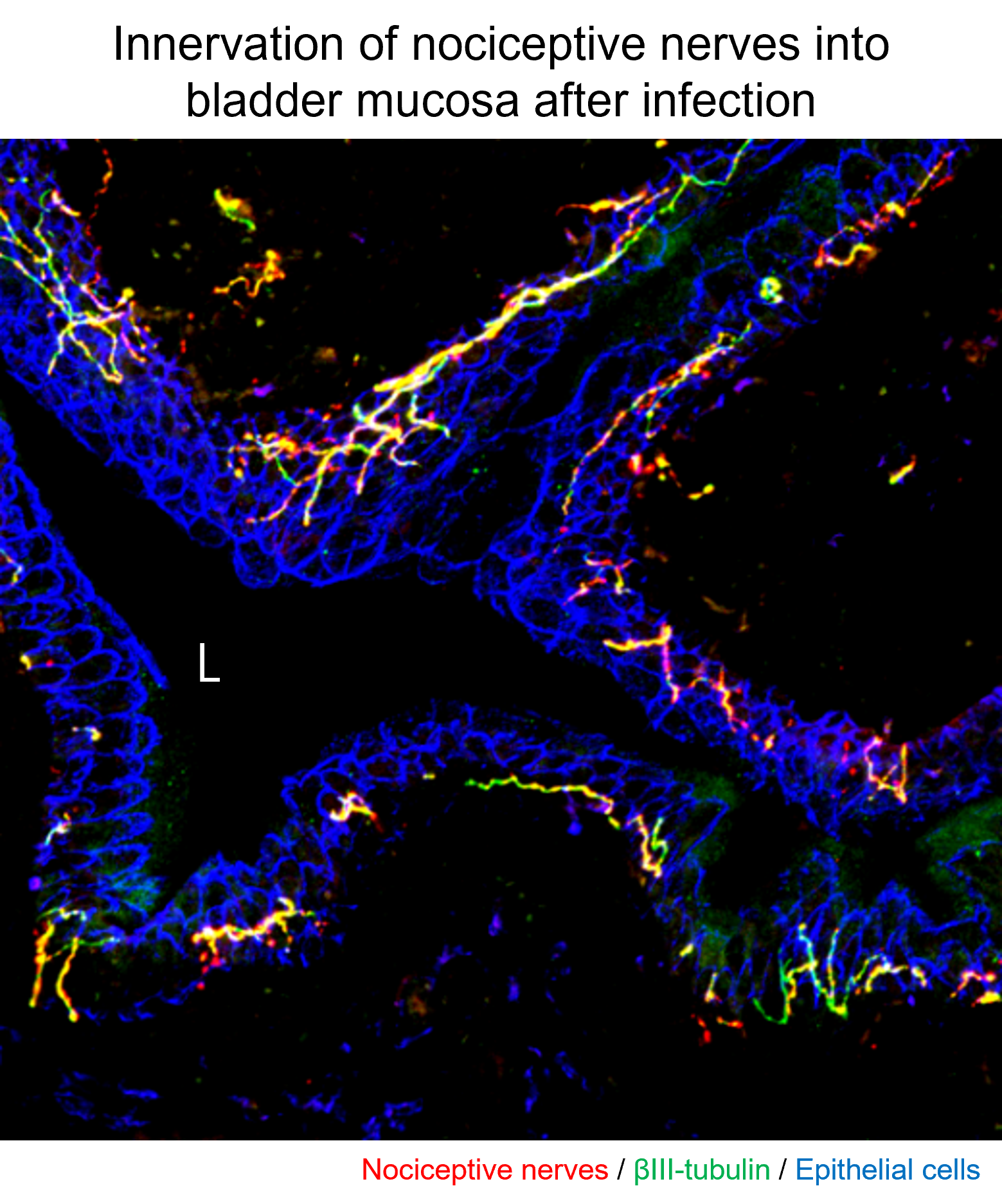 Host–Microbe Interactions and the Urinary MicrobiomeUnderstanding how pathogens, commensal microbes, and host immunity determine susceptibility to urinary tract infectionUrinary tract infection is shaped by complex interactions among pathogens, resident microbial communities, bladder epithelial cells, and the host immune system. Our laboratory investigates how these interactions determine bacterial persistence, recurrent infection, and disease severity.A major focus of our research is the urinary microbiome and its impact on bladder immunity and susceptibility to infection. We study how beneficial and potentially pathogenic members of the microbiome, as well as their metabolites, influence epithelial physiology and innate immune responses.By moving beyond a pathogen-centered view of UTI, we aim to establish a broader understanding of how microbial ecology, host metabolism, epithelial biology, and immunity work together to determine disease outcome. Ultimately, we seek to develop microbiome-based and host-directed strategies for preventing and treating recurrent UTI.Key Research Themes- Bladder epithelial host defense & Immune responses to UTI- Urinary microbiome and microbial metabolites- Microbiome-based and host-directed therapeuticsMast Cell Biology in Infection, Allergy, and Systemic InflammationDefining how mast cells coordinate protective immunity and pathological inflammationMast cells are tissue-resident immune cells strategically positioned at interfaces between the host and the external environment. Although best known for their roles in allergy and anaphylaxis, mast cells also participate in antimicrobial defense, vascular inflammation, tissue injury, and systemic inflammatory responses.Our laboratory investigates the molecular and cellular mechanisms that regulate mast cell activation, granule formation, degranulation, and intercellular communication. We are particularly interested in how mast cells interact with immune cells, platelets, vascular cells, and infected tissues to influence local and systemic inflammation.Current studies also focus on the intracellular and mitochondrial mechanisms that regulate mast cell effector functions. By understanding when mast cells provide beneficial host defense and when their activation becomes pathological, we aim to identify strategies that selectively suppress harmful mast cell responses while preserving protective immunity.Key Research Themes- Mast cell biology in bacterial infection & Sepsis and septic shock- Anaphylaxis and allergic inflammation- Mitochondrial regulation of mast cell function
* Mast cell activation - Captured by confocal microscope & Scanning Electron Microscope

Teaching
학부 수업
면역학I (Immunology I)
응용면역학 (Applied Immunology)
대학원 수업
분자 병리학 (Molecular Pathology)
감염 면역학 (Infection and Immunology)
Available Positions
-